Kalayaan has been collaborating with King’s College London, The Voice of Domestic Workers (VODW) and After Exploitation on the Survivor Futures project which looks at the risk of re-trafficking for domestic workers who return to their home countries.
As part of that project, on Sunday 20th July 2025, 10 members of Kalayaan’s Campaigning Group joined members of VODW in a letter-writing campaign event. The event was held at King’s College and hosted by Dr Ella Parry-Davies who led the group in creative and empowering warm ups. Sophie Levack from Kalayaan described the campaign for a visa regime that empowers migrant domestic workers and protects them from the risk of re-victimisation, and she explained the value and impact of a letter-writing campaign.
The participants wrote powerful letters to their MPs and presented these in creative ways through drawings, collages, and stencil work. Each letter was sent along with a explanatory document that gives additional context to the campaign and sets out a call to action for their support.
Kalayaan participants wrote to Apsana Begum, Rachel Blake, Dawn Butler, Ed Davey, Georgia Gould, Wera Hobhouse, Joe Powell and Emily Thornberry.
We look forward to hearing back from all of these MPs and helping them engage with domestic workers in their campaign for reform of the Overseas Domestic Worker visa.
Currently, thousand of survivors wait years in the National Referral Mechanism (NRM) for a Conclusive Grounds decision as to their status as victims of trafficking and modern slavery. Kalayaan has been campaigning for the Government to grant the right to work to all survivors so that they may regain agency, heal and recover from their experiences, and contribute to the economy.
“We know that victims are waiting far too long for a decision. I witnessed firsthand how detrimental it is to their wellbeing and recovery, to have to wait for a conclusive grounds decision on their case for months, sometimes years. After being brutalised, dehumanised, and exploited, after finding the strength to come forward to authorities, these courageous people have been in limbo, unable to move on with their lives with any certainty or stability.”
The Minister then set out the work she and the Modern Slavery Unit in the Home Office are doing towards remedying these challenges.
While Minister Phillips ought to be commended for the hard work she had undertaken in this area, members of the House of Lords continue to press the Minister for a solution to those survivors facing destitution while backlogs are being dealt with. Indeed, this week, 20 members of the House of Lords sent a response to Minister Phillips raising further issues and asking to hear solutions to these.
“We remain concerned about the wellbeing of the survivors currently in the NRM who will continue to wait for excessive periods until the backlog is dealt with – in two years’ time. We believe granting the right to work to these survivors will dramatically improve their situation and will benefit the UK economy.”
Likewise, Kalayaan thanks Minister Phillips for her response and her hard work in this area. However, we remain concerned that the solutions being implemented will have beneficial effects only in the long run, and that many survivors currently in the NRM continue to languish in a system that forces them into destitution if they do not have the right to work.
Kalayaan will continue to engage with the Minister to understand what solution she might have for survivors urgently and presently suffering from a challenged system that ought to be enabling their recovery but appears to be impeding it.
Kalayaan has published the last of five ‘mini reports’ on the right to work in the National Referral Mechanism (NRM). The series of reports highlights the benefits to be gained by the UK and survivors of human trafficking and modern slavery if every adult in the NRM was granted the right to work.
“Report 5: The Solution” sets out the simple and cost-free way the UK Government can grant the right to work to all survivors in the NRM by changing policy.
Kalayaan’s Sophie Levack drafted this series of reports with Caroline Lewis of Saltworks Law. They have addressed this series of reports to MPs and urge the Government to make a small change in policy to allow this work force to contribute to the UK economy and use work to help them recover from their previous exploitation.
The previous reports in this series set out the current ‘state of play’ for survivors in the NRM without the right to work, make the case for the economic benefits to be gained, show how working will enable survivors to recover, and highlight how having the right to work would reduce the risk of re-exploitation:
Kalayaan has published the fourth of five ‘mini reports’ on the right to work in the National Referral Mechanism (NRM). The series of reports highlights the benefits to be gained by the UK and survivors of human trafficking and modern slavery if every adult in the NRM was granted the right to work.
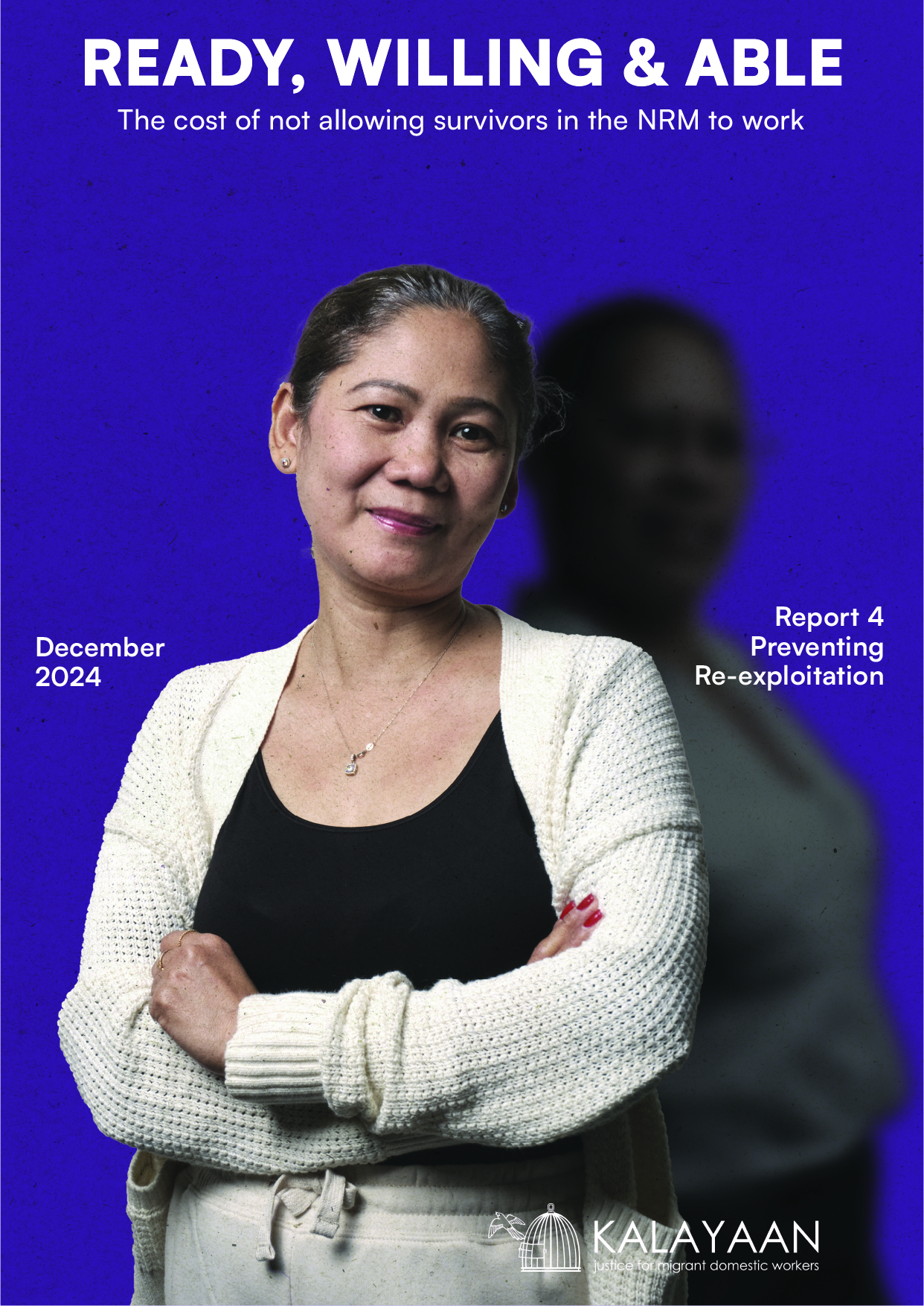
“Report 4: Preventing Re-Exploitation” highlights how the current system may result in some survivors being re-exploited while in the NRM, and it shows how granting survivors the right to work could prevent this risk of re-exploitation
Kalayaan’s Sophie Levack drafted this series of reports with Caroline Lewis of Saltworks Law. They have addressed this series of reports to MPs and urge the Government to make a small change in policy to allow this work force to contribute to the UK economy and use work to help them recover from their previous exploitation.
Kalayaan has published the third of five ‘mini reports’ on the right to work in the National Referral Mechanism (NRM). The series of reports highlights the benefits to be gained by the UK and survivors of human trafficking and modern slavery if every adult in the NRM was granted the right to work.
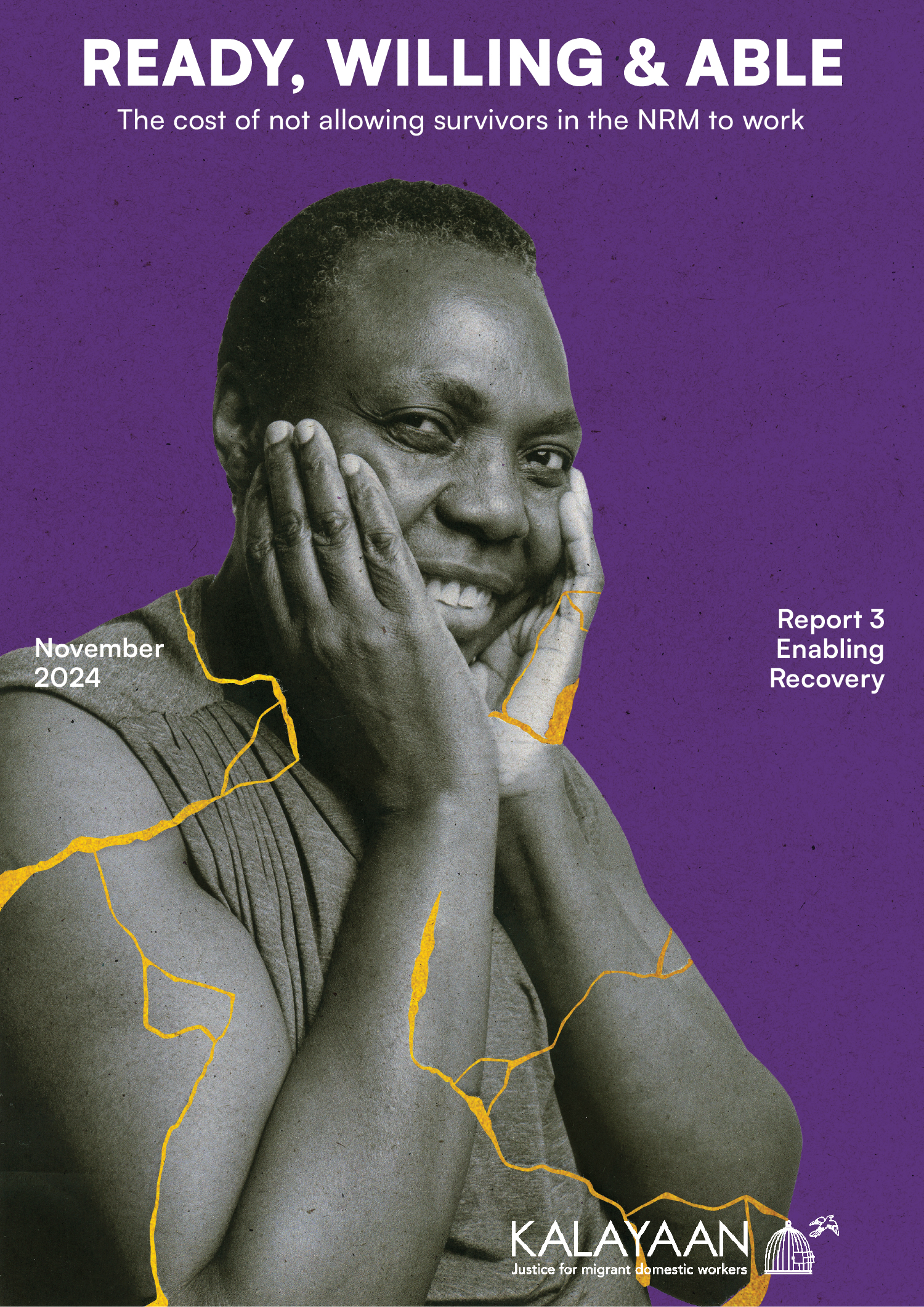
“Report 3: Enabling Recovery” shows how being allowed to work would facilitate recovery and diminish the health and mental health issues of potential victims in the NRM.
Kalayaan’s Sophie Levack drafted this series of reports with Caroline Lewis of Saltworks Law. They have addressed this series of reports to MPs and urge the Government to make a small change in policy to allow this work force to contribute to the UK economy and use work to help them recover from their previous exploitation.
Kalayaan has published the second of five ‘mini reports’ on the right to work in the National Referral Mechanism (NRM). The series of reports highlights the benefits to be gained by the UK and survivors of human trafficking and modern slavery if every adult in the NRM was granted the right to work.
“Report 2: The Economic Benefits” demonstrates how granting survivors of trafficking the right to work in the NRM makes sense economically and how it can ease labour shortages in the UK.
Crucially, it shows that the UK is losing out on £36 million in revenue per year from income tax and National Insurance contributions by not allowing thousands of ready, willing and able workers in the NRM to make an honest living while they await a Conclusive Grounds decision.
Kalayaan’s Sophie Levack drafted this series of reports with Caroline Lewis of Saltworks Law. They have addressed this series of reports to MPs and urge the Government to make a small change in policy to allow this work force to contribute to the UK economy and use work to help them recover from their previous exploitation.
Report 1 of the series sets out the current state of play for thousands of adult foreign nationals prevented from working due to arbitrary policies that prevent a ready, willing and able workforce from contributing to British society and from regaining their agency after having been exploited.
Report 2 will demonstrate how granting survivors of trafficking the right to work makes sense economically.
Report 3 will show how being allowed to work would facilitate recovery and diminish health and mental health issues of survivors in the NRM.
Report 4 will highlight how granting survivors of trafficking the right to work could reduce their risk of re-exploitation.
And, finally, Report 5 will set out the simple and cost-free way the UK Government can grant the right to work to this workforce.
Kalayaan’s Sophie Levack drafted this series of reports with Caroline Lewis of Saltworks Law. They have addressed this series of reports to MPs and launched the series at an event in Parliament today.
The rest of the reports will be published every two to three weeks, so stay tuned!
Many reports have been written on this subject by organisations in the sector. To give you background to this incredible work, we have summarised the reports into an Annex available here.
In the week before Anti-Slavery Day, on 11 October 2024, Kalayaan held a Showcase Event to highlight and celebrate the amazing work done by members of our Campaigning Group this year.
Kalayaan’s Campaigning Group was formed in March 2024 and brings together migrant domestic workers (MDWs) of different nationalities to work on projects that aim to increase public awareness of campaigns for MDWs.
The event was held at the Abbey Centre in Westminster and was attended by 70 people. The Campaigning Group’s work was showcased through exhibitions and interactive stalls where attendees could engage with the Zine’s content, listen to the podcast episode, and leave their messages for migrant domestic workers.
Following this, members of the Campaigning Group presented onstage to talk about various aspects of their work throughout the year, including the campaigns for a better Overseas Domestic Worker visa, the Right to Work for all in the National Referral Mechanism (NRM) and better protections for migrant domestic workers in the UK. Members of the Group spoke about the challenges of living as a migrant in the UK and how existing policies have impacted their lives, from the Overseas Domestic Worker visa to the Life in the UK exam. Attendees listened to Q&As about the experience of creating the podcast and learning points for professionals working with MDWs.
This Event was a culmination of the Campaigning Group’s passion, commitment, and hard work over the last eight months. We thank those who attended to support the members and learn more about their campaigns and look forward to what the Group brings in 2025.
Earlier this month our Policy Officer Avril visited Brighton and Liverpool to participate in the Liberal Democrats and Labour Party Conferences, talking to MPs, policy makers and experts about the changes we need to end migrant worker exploitation.
Conference season comes at an interesting time this year following the General Election and the summer riots. At Kalayaan, we have been reflecting about how we can play our part in standing against racism whilst managing risks to our staff, our clients and the community we serve.
As a small charity we felt it important that we attend and take our campaign message directly to parliamentarians. Unfortunately we were not in a position to bring members of our Campaign Group with us, but we hope to review this ahead of Conference next year.
First up, we attended Brighton on a gloriously sunny Monday. We heard from a number of Liberal Democrat MPs about being a constructive opposition. With this in mind, we spoke to MPs from across the UK about the importance of worker rights and how the trafficking and modern slavery mechanisms are a reactionary measure which fails to prevent labour law violations escalating. Avril spoke with her new MP in Kent and hopes to speak with him more in the coming weeks about working with his office more closely.
The following week we went to Liverpool for Labour’s Conference. We were joined on Sunday by The Voice of Domestic Workers, and a coach-load of their members. We gathered outside the main auditorium where MPs were meeting inside. Members from The Voice performed a dramatisation of workers being interviewed by the Home Office and lots of dance numbers including their own version of ‘I will survive’. The rain failed to dampen our spirits.
On Monday and Tuesday, Avril joined forces with Marissa Begonia and Mimi Jamalsco from The Voice attending fringe meetings and speaking to MPs about the role Labour played in 1998 when they introduced the original Overseas Domestic Worker visa. We also spoke of the exploitation of migrant workers in sectors with high rates of abuse and the need to look at systemic solutions to stop this from happening.
The Prime Minister addressed Conference on Tuesday, 24 September. Although we were pleased to hear him say, ‘the debate is not about the worth of migrants. That is toxic and we must move beyond it’, we know this new Government has work to do to make those words a reality. All migrants deserve to have a place to call home, fair and decent work conditions and to feel welcomed in their communities. Migrant domestic workers remain one of the most at-risk work populations whilst their six-month visa remains non-renewable, trapping them without options and redress. Until such time domestic workers have rights that keep them safe at work and able to challenge abuse, our work campaigning for change continues.
For more information about the campaign for worker rights, read our report 12 Years of Modern Slavery here .