The Zine contains the work of our members from March-June 2024, detailing campaign goals for migrant domestic workers, our thoughts about current conditions in the UK for MDWs and our aspirations for the future.
It celebrates key migrant domestic workers past and present and engages with historic Kalayaan campaigns through conversations with archive photography.
Our experiences are shared within these pages, which we hope will give strength to others as well as help to bring about public awareness and change from policymakers.
The Zine finishes with creative work and a guide to key organisations supporting migrant domestic workers.
The powerful photography of Camila Almeida is interwoven throughout, alongside the eye catching graphic design of Coco Sohiez.
We hope you enjoy reading it and that it gives you courage to stand with us in our campaign to improve the rights of migrant domestic workers in the UK.
Printed copies of the Zine will be available at our Showcase Event in October – contact rebecca@kalayaan.org.uk for more information.
Kalayaan and many non-statutory First Responders have signed a joint statement asking for the Home Office to implement solutions to resolve the ongoing First Responder capacity crisis.
The joint statement comes as Kalayaan and ATMG publish a briefing that provides an updated overview of the challenges faced by non-statutory First Responders in referring potential survivors to the National Referral Mechanism (NRM) between December 2023 and June 2024, building on previous findings by Kalayaan in 2023 and February 2024.
The briefing sets out the findings from a survey of organisations in the anti-trafficking and modern slavery sector. The results of the survey show that it is increasingly difficult for organisations to help survivors to appropriate First Responders, thus causing a bottle neck for potential survivors of trafficking and modern slavery to access identification, support and protection in the NRM.
Referring to the findings in the briefing, in the joint statement, Kalayaan and other non-statutory First Responders highlight the vital role that non-statutory First Responder organisations play in referring potential survivors into the NRM due to their independence and their expertise. They point out their extremely limited resources and the unsustainability of the current situation, calling for urgent reform, including:
Providing funding for organisations to carry out their First Responder roles
Considering and deciding on existing applications from specialist front-line organisations to become non-statutory First Responders
Establishing a recruitment process without further delay for prospective organisations to apply
Developing and maintaining a nationwide training programme with minimum standards for both statutory and non-statutory First Responders
Revising the digital NRM referral form in consultation with First Responders to enable a more efficient referral pathway.
The briefing and the joint statement have been sent to Jess Phillips MP and The Modern Slavery Unit, and Kalayaan hopes that the Home Office will agree to meet with the signatories to begin working towards the proposed solutions.
For further information or media enquiries, please contact Sophie Levack, Policy Officer: sophie@kalayaan.org.uk.
On International Domestic Workers’ Day 2024, Kalayaan releases our new report, 12 years of modern slavery: the smokescreen used to deflect state accountability for migrant domestic workers.
Whilst acknowledging that exploitation is multifaceted and abusive employers must be held accountable, Kalayaan’s focus in our new report is demonstrating the role and legal duty the state has to ensure that our legal systems are compatible with our positive obligations to protect and safeguard all workers.
Our report reveals the smokescreen the previous Government has used for the past 12 years when denying calls to guarantee the safety of this workforce at work in the UK. Kalayaan shines a spotlight on these myths and demonstrates that they are not rooted in evidence and do not meet the needs of workers, placing them at risk of harm.
Included in our report is new evidence of the abuse experienced by domestic workers in the UK. Rates of abuse are significantly higher following drastic changes made to the domestic worker visa 12 years ago, in April 2012. Changes introduced in 2016 have made little difference with abuse remaining at consistently higher levels than was the case pre-April 2012.
Numerous attempts have been made by workers and their supporters over the past 12 years to reverse these changes. Parliamentarians have been lobbied, petitions have been signed, and workers have bravely spoken out. Civil society organisations have engaged with various government-stakeholder groups and a number of international monitoring mechanisms have expressed concern about the UK’s legislative framework and how it puts workers at unacceptable risk. All attempts to restore rights have so far been rejected.
Kalayaan’s report scrutinises and dismantles 8 key myths that have been relied on when rejecting calls to reinstate labour law rights for workers. Ultimately, the report finds that the myths relied upon by the Government during the past 12 years are a smokescreen for the state’s failure to ensure our legal system does not facilitate the abuse and exploitation of this workforce.
Kalayaan is only making one recommendation in our report. That the incoming Government does not seek to hide behind myths that are not rooted in evidence, and which do not meet the needs of workers. The incoming Government must engage with our evidence and take steps to restore the pre-2012 visa regime with rights to ensure the safety and dignity of all workers whilst at work in the UK.
The right to change employer
The right to renew their domestic worker visa annually
The right to be joined by spouses, partners and children under 18 and
The right to settle in the UK after five years of continuous work as a domestic worker.
For further information about our report and media enquiries, please contact avril@kalayaan.org.uk.
By Becca Hirst, Community Engagement Lead for Kalayaan.
On 3 April 2024, Kalayaan hosted a coffee morning to mark 12 years since the restrictive 6-month, non-renewable Overseas Domestic Worker visa was instated in 2012 and reflect on the past, present and future of the ODW visa.
The event was held at our community centre in Holland Park where Kalayaan has been based since the late 1970s, a place rich in campaigning history. Here we showcased 3 photographic exhibits to shine a spotlight on issues affecting migrant domestic workers in the UK.
The first was contemporary series ‘A Place at the Table’ by Camila Almeida who worked with the Voice of Domestic Workers to construct deeply evocative images of migrant domestic workers in symbolic spaces within the home and workplace.
On the reverse side, we displayed Pia Tryde’s 1990s photographic work of migrant domestic workers struggling whilst outside of UK immigration laws and protections. Some of these photographs included captions and handwritten notes from the women depicted reflecting on being made to feel ‘illegal’ in the UK, their fear around the lack of protection offered to them and the conditions they bore in order to provide for their families in countries of origin. It was striking to compare the almost identical commentary of ODWs in the UK in the 1990s – prior to 1998 when MDWs were not recognised and protected under UK law – and ODWs in 2024, living under the restrictions of a 6-month visa which fails to protect migrant domestic workers across the spectrum of exploitation.
A large screen display played rolling footage of archive photography centring around Kalayaan’s past campaigns for the domestic worker visa. Attendees including original Kalayaan and Waling Waling campaigners and former Assistant General Secretary of Unite, Diana Holland, recognised themselves in photographs from the long campaign to champion rights for migrant domestic workers in the UK. Media clippings from the 1970s-2010s reflected a timeline of rights being campaigned for, won and then reversed. Reflecting on the latter was a bitter tonic but articles celebrating the outcome of the 10-year long campaign leading to the 1998 visa (internationally recognised as the visa which offered the best protections for MDWs in this country), offered much-needed hope to the current campaign that collective action will prevail.
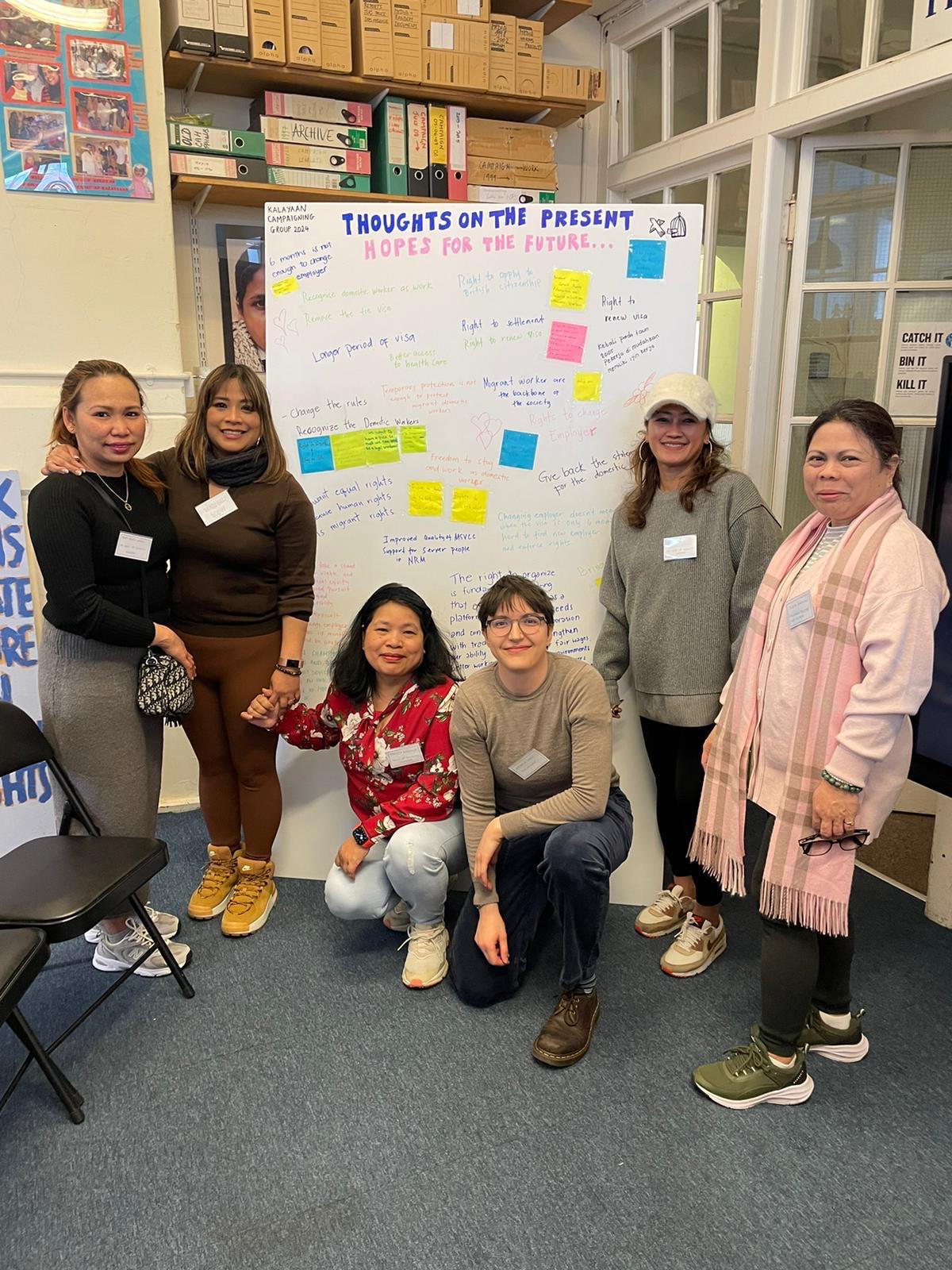
Members of Kalayaan’s campaigning group wrote their hopes and thoughts for the future of migrant domestic workers in the UK on a large display board present for all to see. Attendees were encouraged to do the same in an interactive scrapbook. Coffee, tea and pastries were served as we spoke about our past challenges and recent achievements, including the government laying legislation to abolish the Family Worker Exemption in the Minimum Wage Regulations, and our hopes and plans for the future as we re-double our efforts to lobby for change in this election year.
The coffee morning emphasised the importance of migrant domestic workers having a seat at the table and speaking to policymakers and parliamentarians to lobby for their rights. Prior to the event, Kalayaan and the Voice of Domestic Workers, including an expert by experience, spoke with Felicity Buchan, MP for Kensington, to ask for help building parliamentary awareness of the need for improved protections for MDWs. We were glad that Felicity offered to write to the Home Secretary with our concerns and will look forward to reading the response from James Cleverly. In the coming weeks, Kalayaan and the Voice of Domestic Workers will be speaking with Stephen Timms, MP for East Ham, about the ODW visa and arranging a Westminster Hall debate to bring the issue to the forefront.
Kalayaan calls for an Overseas Domestic Worker visa that is: 12 months long; renewable; allows the domestic worker to change employer and has an option to lead to settlement.
We thank the following organisations for joining us in solidarity at the event:
FLEX
Free Movement
Haringey Migrant Centre
Hestia
Human Trafficking Foundation
Kanlungan
Lawyery
Migrant Democracy Project
Redmans Solicitors
Reuters
Right to Remain
Royal Borough of Kensington and Chelsea council
Unite
Voice of Domestic Workers
Waling Waling
Work Rights Centre
With many thanks to Margaret Healy for her assistance looking through the archives and Matt Reynolds for his help on the day.
Our Policy Officer, Sophie Levack, attended and made a statement at the Human Rights Committee’s 140th Session in Geneva on 11 March 2024. She tells us about her experience.
It is 11:30am in Palais Wilson, and the corridor outside the OHCHR formal meeting room is packed. The Human Rights Committee is finishing up its meeting with the UK’s Equality and Human Rights Commission. NGOs presenting statements about human rights in Serbia, Guyana, Indonesia, and the UK are waiting for their turn to speak to the Committee Members. When we are finally let in, not everyone can find a seat. There are a lot of representatives here. There is a lot to be said.
NGO representatives are given two minutes to make their oral statement, no more. My colleagues and I have tried very hard to condense the key issues faced by domestic workers in the UK into a succinct statement. It was tricky but we did it. The Chair of the Committee introduces each representative and we each make our statement, conscious of the large timer in the corner counting down the seconds and trying to avoid looking up at the huge projection of each of us speaking.
I talk to the Committee about the ODW visa and how it prevents migrant domestic workers from accessing justice, I describe the crisis in the NRM: how it only supports those who have been trafficked and exploited, but not those with real employment grievances; how a lack of non-statutory first responders has created a bottleneck for those who could qualify for support, but cannot access it; and how once in the NRM, many migrants workers are denied the right to work, waiting years for a decision and sometimes taking risky, unregulated, and often exploitative jobs to make ends meet, all while in a system that was supposedly designed to protect them.
After the meeting, I meet with many NGO representatives who gave evidence of similar issues in their sector. We debrief over lunch and discuss issues in more depth. At 2pm, we are invited into an informal meeting with some of the Committee Members. They have reviewed our written submissions and have some follow-up questions. The issues are vast and many. Again, there are so many representatives here: in a smaller room, many of us are either standing or sitting on the floor. It seems the Committee has never had so many NGOs submit evidence for the UK before.
The day ends with another informal debrief. We hear what the Equality and Human Rights Commission submitted to the Committee earlier that day. We discuss other issues: access to justice, detention, health.
There is a lot of work to do, but there are so many passionate and driven people in the sector, it gives me hope that we might see change. Soon, hopefully.
Kalayaan looks forward to following up with the United Nations and our allies working in the sector and in other social justice issues as our work to restore rights and protect all workers in the UK continues.
Sophie’s speech delivered to the Human Rights Committee can be found here.
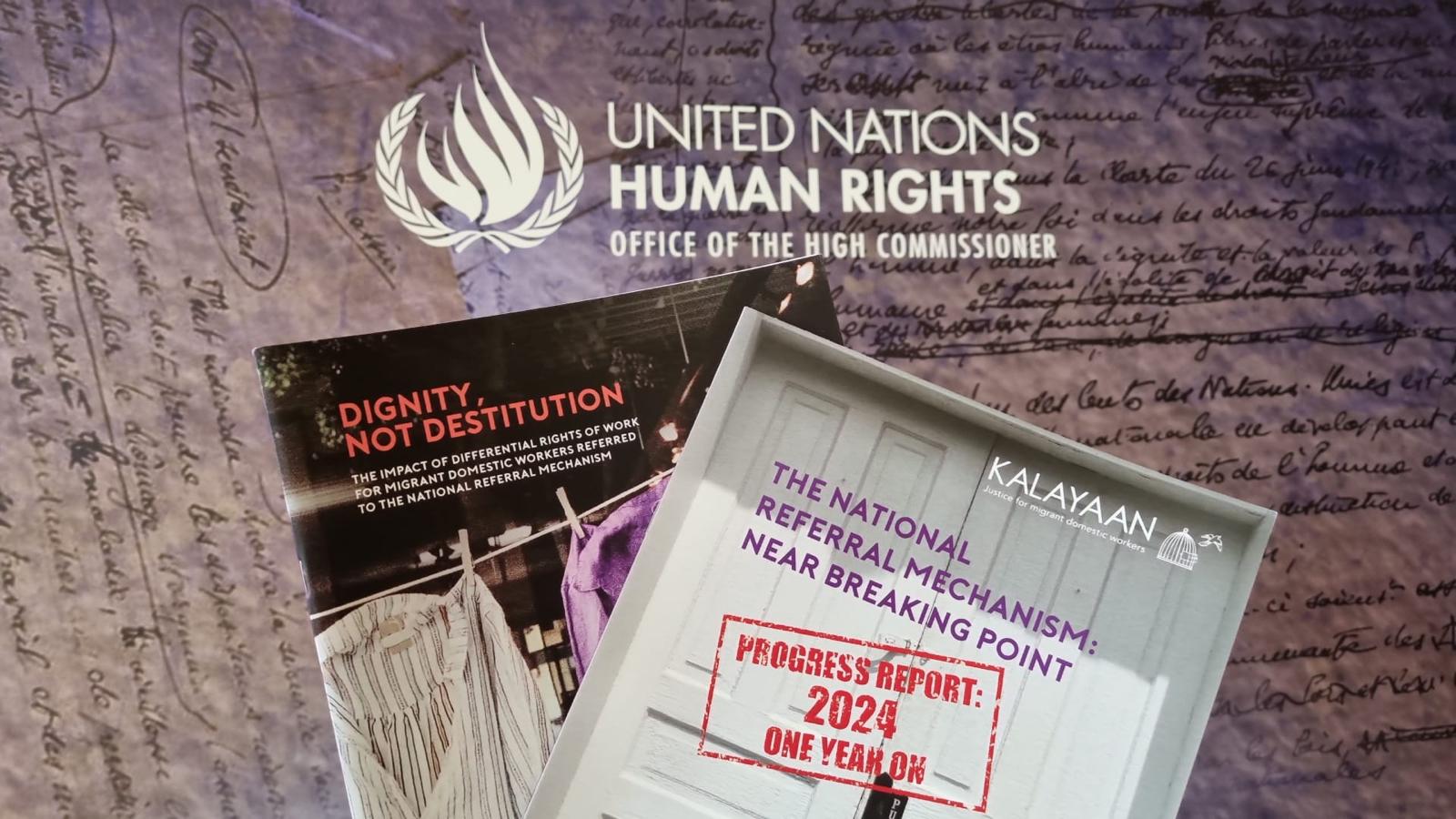
Today, ahead of the Human Trafficking Foundation’s forum held at Linklaters, Kalayaan is launching our new report, ‘The National Referral Mechanism: Near Breaking Point, Progress Report 2024: One Year On.
This report provides an overview of the last 12 months relating to the crisis facing First Responder Organisations and their capacity to assist and safeguard survivors of trafficking and modern slavery.
In February 2023, Kalayaan published our initial report, laying bare the pressures facing First Responder Organisations, specifically non-statutory organisations, tasked with identifying and assisting survivors. We are disappointed to report that our worst fears have been realised over the past 12 months: the Government has failed to act, putting survivors at unnecessary risk as they are effectively barred from accessing the National Referral Mechanism (NRM) and the protections it provides.
Our new report includes the real-life cases of Caroline and Teresa, women who had been trafficked and needed to enter the NRM to access immediate support, but who had to endure weeks of waiting. Delays entering the NRM places unnecessary strain on specialist, front line, support organisations, who report not knowing what to do in the absence of a functioning First Responder system.
Kalayaan was pleased to see the US State Department and Home Affairs Committee in 2023 back our recommendation to increase the number of organisations designated as First Responders.
Our recommendations included in our updated 2024 report remain the same as the ones we called for in 2023:
Consider and decide on existing applications from specialist front line organisations to become a First Responder Organisation
Establish a recruitment process without further delay for prospective organisations to be able to apply
Develop and maintain a nationwide training programme for both statutory and non-statutory First Responder Organisations
Provide funding for First Responder Organisations to carry out their roles
We urge the Government to take immediate action without further delay and implement our recommendations in full.
For further information and any press enquiries, please contact info@kalayaan.org.uk.
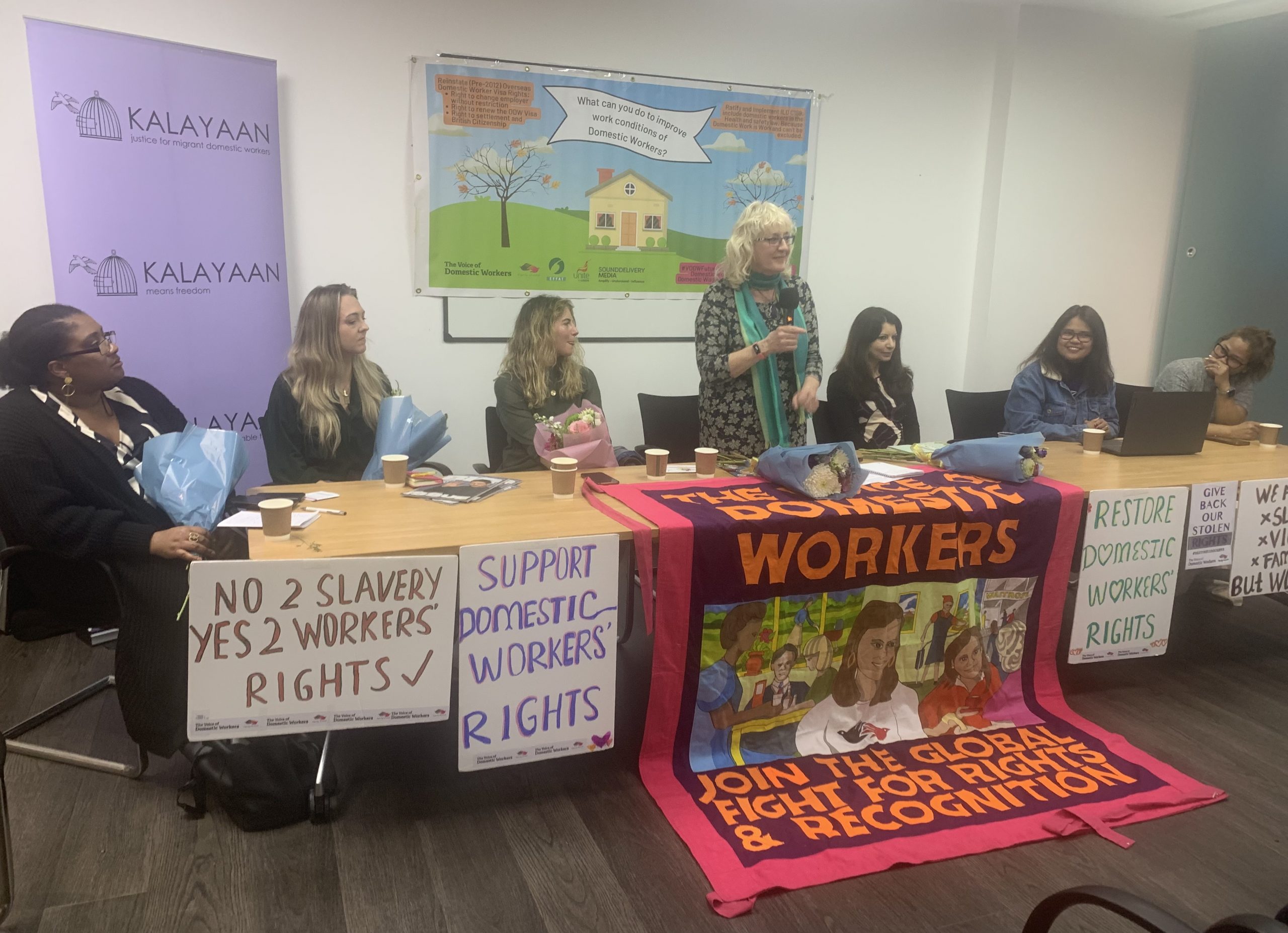
On 4 April 2023, ahead of the 11 year anniversary of the visa terms being changed and migrant domestic workers being stripped of their rights in the UK, workers, activists and supporters came together for a screening, followed by a panel discussion about how best to chart a path forward to access justice and ultimately see rights restored.
After a screening of ‘My Home Is Not My Home’ we heard from an excellent panel of speakers including migrant domestic workers, Natalie Sedacca, law professor and Kalayaan trustee, Zoe Gardner, migration and protection expert, Evie Breese, journalist covering worker rights at The Big Issue and Bell Ribeiro-Addy, Labour Member of Parliament for Streatham. Our event was hosted by Unite the Union and chaired by Diana Holland, Assistant General Secretary for Equalities.
We heard workers speak clearly of the need for a bigger platform so that their experiences and demands for rights are known by a wider audience. Mimi Jalmasco said workers had been speaking out for 11 years and wanted to know why no action had been taken by the UK Government. She asked if migrant domestic workers’ rights are less worthy than the demands of abusive employers that the Government wants to attract to visit the UK.
Natalie then discussed in a practical sense what it would mean should workers have their rights restored. She spoke of the legal framework as it currently applies, including how some employers use the defence of the Family Worker Exemption when a worker challenges their failure to pay their salary in line with the UK’s National Minimum Wage.
Zoe followed next and praised the work already done by workers, and their supporters including Kalayaan and The Voice of Domestic Workers, in speaking out so well on the abuse perpetrated not by employers, but by the Government in not allowing workers to renew their visa. Zoe drew on learnings from the Windrush scandal and how it was a scandal long before it unfolded to the general public. She argued that the refugee and migrant sector should work together to create a similar moment when the Government finally realises the vital role played by this workforce and how they should have their rights restored.
Evie discussed the important role of the media and how stories of vulnerable workers need to be sensitively told whilst conveying the actual reality faced by workers every day at work. Such stories can only be told with the bravery of individuals and the support provided by charities working with them. Two such individuals had spoken to The Big Issue and their stories of survival are included in this week’s release of the magazine, available both online and in hard copy.
Our final panellist was Bell who spoke of the need to wilfully instruct politicians when it comes to important and urgent policy areas such as worker rights. She spoke of the need to hear directly from migrant workers and the experiences they have gone through so that politicians have their perspective inform the debate. She also stressed the importance of making sure that those who can vote are encouraged to do so, and to take part in democracy, rather than stay at home on voting day.
We were pleased to have some time at the end for our guests to provide their observations and ask questions to the panellists on how they could lend their support to the campaign to restore rights. We rounded of the evening with pizzas for everyone and more rich discussion amongst our guests with some networking.
Did you attend our event? We are continuously looking for ways to improve so if you have feedback or suggestions for future events, please do get in touch and email us at info@kalayaan.org.uk.
Kalayaan would like to give particular thanks to our volunteer Matt Reynolds for his time and assistance with helping us to put on this event. Thank you Matt.
Today, ahead of the Human Trafficking Foundation‘s forum, held at Linklaters, Kalayaan has published our report: ‘The National Referral Mechanism: Near Breaking Point‘.
This report is a rapid response to the pressing need to review the numbers of, and available resources to, designated First Responder Organisations in the UK.
It has long been acknowledged that the numbers of survivors being identified are the tip of the iceberg, with the actual number of people exploited in the UK amounting to 10 times more.
There has been a lack of action on the part of the UK Government to acknowledge the pressing need for an increase in the numbers of First Responder Organisations, together with the requisite resources.
This cannot continue. The result is that survivors, if and when they are identified, cannot access the one system used in the UK – the NRM – to be identified, safeguarded and offered support. This situation has been deteriorating for a number of years but it now reaches breaking point. This means survivors are at real risk of experiencing further harm and abuse, including treatment that amounts to slavery.
Kalayaan will be presenting our report at the Human Trafficking Foundation’s forum on 22 February 2023 and have been asked to lead the conversation on the issue of capacity of First Responder Organisations.
This follows the Urgent Public Announcement Kalayaan made on 30 January 2023 in which we highlighted and flagged our concerns and the real life implications it will have on survivors.
We look forward to the conversations at the forum today and hope the Home Office shall be listening.
At time of this report’s publication, and 2.5 weeks after first raising the alarm of the NRM nearing breaking point, Kalayaan has yet to meet with any representatives from the Home Office.
For further information and press enquiries please contact info@kalayaan.org.uk.
Kalayaan has today issued a Public Announcement to put the UK Government on notice of the pressing need to revisit the issue of the training and appointment of First Responder Organisations across the UK.
These organisations – a mixture of both statutory and non-statutory – are appointed to this role having been identified as having the requisite expertise and knowledge to identify, safeguard and support slavery survivors.
Our Public Announcement can be found by clicking here.
For further information and press enquiries please contact avril@kalayaan.org.uk.
Contact your MP to ask they support rights for migrant domestic workers… here’s how:
1. READ OUR OPEN LETTER – A Call to the UK Government to reinstate the original Overseas Domestic Worker Visa
2. FIND YOUR MP– Using your postcode, find out which MP represents you
3. TELL YOUR MP WHY THIS MATTERS – Email your MP using our templates, or feel free to amend them to tell your MP why migrant domestic workers should be protected
4. FEEDBACK ANY RESPONSES – Let us know if your MP replies to you so that we can build an alliance of MPs standing up for rights for migrant domestic workers.
Please forward any replies you receive to: info@kalayaan.org.uk.
5. GET INVOLVED AND STAY UP TO DATE – For details of other campaigns Kalayaan is working on, please click here.